Thursday, September 7, 2017

Day 4: Meeting Friends and Family

They’re just like you and me.

They have their time for work and a professional life to attend to. They have family they catch up with. They host dinners for friends, or go over to a mate’s house and be the guests. And, they have rest days for chilling and down times for watching Netflix.

Perhaps, what’s not so much like you and me, is how climbing is just so central to all of it.

Today was supposed to be a rest day, but because Coralie’s energy is so contagious (she is Caroline’s climbing student and overflowing with motivation), Miel and I joined her for a short morning session in James and Caro’s “woody”.

A woody is a climbing term for a (usually indoor) home gym, and Onceuponaclimb has a really good one in their attic. Probably around 25 square meters, it is heavily inclined, with all four walls meeting at the top for some solid roof climbing, and studded with moderately-open to downright-crimpy holds: Three circuits of 30-40 moves instantly gave us fat forearms.

Memorizing the 40 moves.

Over lunch, we found out that James and Caro would be going out for a short excursion in the mountains. Being assured that it would not be too tiring (it was supposed to be our rest day, after all!), Miel and I hopped into the car and found ourselves spending a pleasant afternoon with Caro’s dad, plus another friend and her little boy Hugo.

Car buddies
We went to Mejannes-le-Clap, somewhere northeast of Connaux. It is a sport climbing crag in itself, but we spent the hours crafting a mini adventure for Hugo: We crawled in and out of limestone tunnels. We abseiled (rapelled) from one tunnel exit that terminates in the middle of a rock, like a pipe with no cover and spewing contents out like a waterfall.


The tunnel's rappel exit


Just 5-10 meters away from these tunnels, a short Tyrolean traverse is setup on adjacent limestone towers. Apart from crossing through the free space on two fixed lines, one is invited to traverse around towers with your bare hands. And with nothing but openness and the wind blowing behind you, and seeing nothing but the rock, your tired hands, and 2 pairs of carabiners in front of you to protect your life – the traverse was both a heart-stopper and confidence-builder for little Hugo.


Hugo taking on the Tyrolean traverse, as Caroline assists
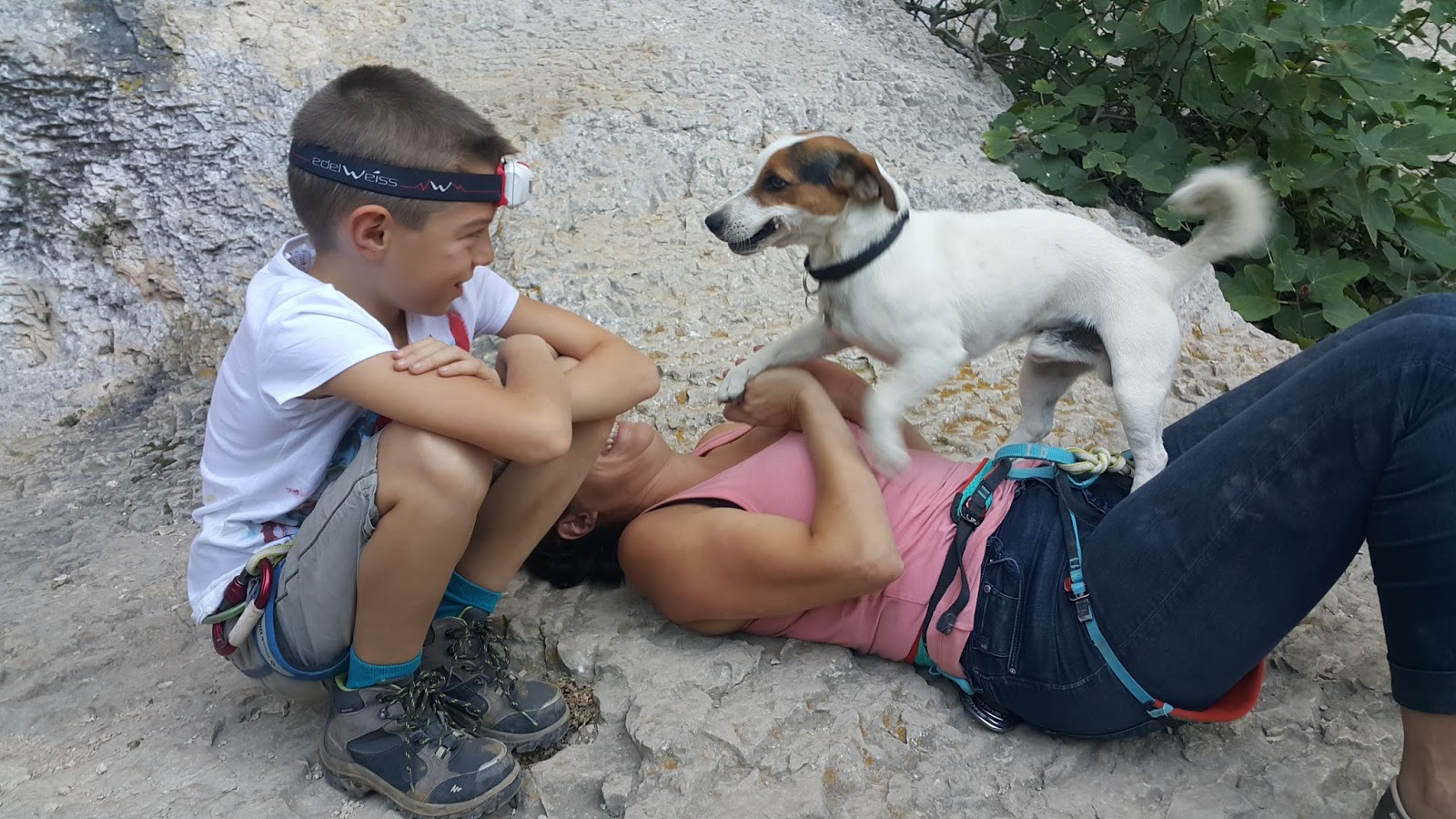
Chilling!
Back at the headquarters, James and Caro invited two friends over for dinner. Caro’s dad decided to stay on for the party, and setup the fire for grilling. We had wine, crostini and foie gras while doing dinner preps. The two friends brought their beautiful, big, white shepherd dog named Ever. The meal consisted of home-made fries, barbecued steak and sausages, and Caro’s steak tartare, which we enjoyed al fresco in their island patio, by the grill.


Fire-grilled steak

My first steak tartare ever!


Dinner wound down with everyone scurrying into the actual dining area, as the temperatures began to drop, and the even the locals putting on their jackets. They taught us about the “mistral”, a strong, cold, wind that affects the south of France. We learned about the guy’s occupation as a designer/builder of walls for homes and various structures. He, in fact, was the one who finished the bedroom where Miel and I are staying in.

Good nights were exchanged around 11:00 PM. After all, there was work the next day for the dinner guests. As for us, there was no question as to what was lined up in our schedule. We were looking forward to more hours of climbing together. The only thing to figure out was which area we would be visiting, and that’s a surprise for the following day.

Wednesday, September 6, 2017

Day 2 to 3: Everything Is New

It’s the most obvious point of attention, and without doubt, one that piques my interest all the time: The landscapes. As soon as the plane flew over Paris, I couldn’t help but admire the large patches of green punctuating the city. In the train to Valence, I watched open fields and mountain silhouettes on the window. And as we drove to the crags, vineyards and olive tree plantations were as abundant as coconut trees in the Philippines. They were just everywhere.


These two days for me were as much about experiencing the new climbing styles as it was taking in all the new-ness of being in this area of France. The peacefulness and quietness of a small village, the days that start late and end late, the fresh cold air that gets locked inside a stone house.


Driving 5-10km out of Connaux could already take you to your nearest climbing area (La Capelle), through narrow but well-paved, bending roads that let cars run 60-90km per hour. There seems to be dozens of kinds of road signs to remember, and everyone follows them, down to the 50km speed limit when you’re inside a village.

Driving 50km will take you to even more crags (in our case, in Mouries). Going further out boasted more greeneries, wide flowing rivers, and quaint villages that all look like they’re over 300 years old because of all the stone and brick finishes. Hill tops are almost always crowned with a castle, and always made me do a double take.

So it was just to my excitement that we could easily check out one of these ruins, which we did after a day in Mouries. And that’s one of the coolest things, too. Because the sun doesn’t set until 8pm, and there is no traffic to get from Point A to B, we could drive for just 10 minutes, hike for another 10, and be on the very top of some century-old structure. Oh, getting to the top includes some low-ball wall climbing because some part of the stairs have been destroyed.


Ah, but we are here for climbing, right? ;)

Mouries was actually Day 2, and it’s an old limestone crag that sticks out for looking like hardbound books forced to stand on their spines. The faces are flat like a book cover, too, and, as expected from these smooth faces, are favorable to those with strong fingers. The routes were a crimp fest, but because it stays in the shade for the whole day, the tiny features had nice friction.


Another new and interesting thing to see were the old type of hangers on the rock. They were old-style bolts that were hand-drilled! So the protection came slightly fewer in between, because you can imagine how much work would go into drilling in one bolt.

La Capelle was climbing day number three, and to our surprise, it’s a 5-minute drive with excellent sandstone bouldering. Miel and I can’t help but be amazed by how convenient the climbing area is, because you can park right in the middle of the village, by the church, and walk 5 minutes up and be in the middle of 10-15 foot boulders.

The boulders aren’t too high that everything's under the trees (decent shade), the landings are flat, and there’s a good variety of styles to choose from, from slabs and roofs to pinchy and crimpy problems. We tried problems that had slopers and open holds, and they would stick, just because there was enough granules (and possibly, relatively good conditions) that would bite into our skins.


The boulders have interesting names, such as the Elephant Rock and Lion Rock, named so because the rocks really look like faces of the animals. And yes, the rocks are even properly labeled with signs and the trails interspersed with symbol and color-coded markers; so even without a topo or guidebook, we could easily spend days here and not run out of things to do.

We ended Day 3 by visiting Pont du Gard, a historical landmark and apparently a UNESCO heritage site. It’s an ancient masterpiece: An aqueduct built in 50 AD (the 1st century!!!), built by the Romans at that time to supply water to the city of Nimes. To get an idea of its majesty, the original construction ran 50 km long, and stands 50 m high, built from limestone blocks that is plentiful in the region (no wonder there is so much climbing here, ha!) Or maybe a better scale reference: The biggest arch of the aqueduct stands 25 m high. And that’s just ONE arch!


With our new friend and tour guide for the day,
local climber extraordinaire, Coralie

Safe to say that that’s already a lot to take in for two days, and we’re only getting started.